Type “can I afford to retire?” into a search engine and you get a calculator, a rule of thumb, or a number someone else needed. None of them can answer it, because the answer isn’t a number you look up. It comes out of five things about you:
- What you spend. Not your income: what it costs to live the way you want to, after tax.
- When you stop working. Every year earlier is one less year of saving and one more year of drawing.
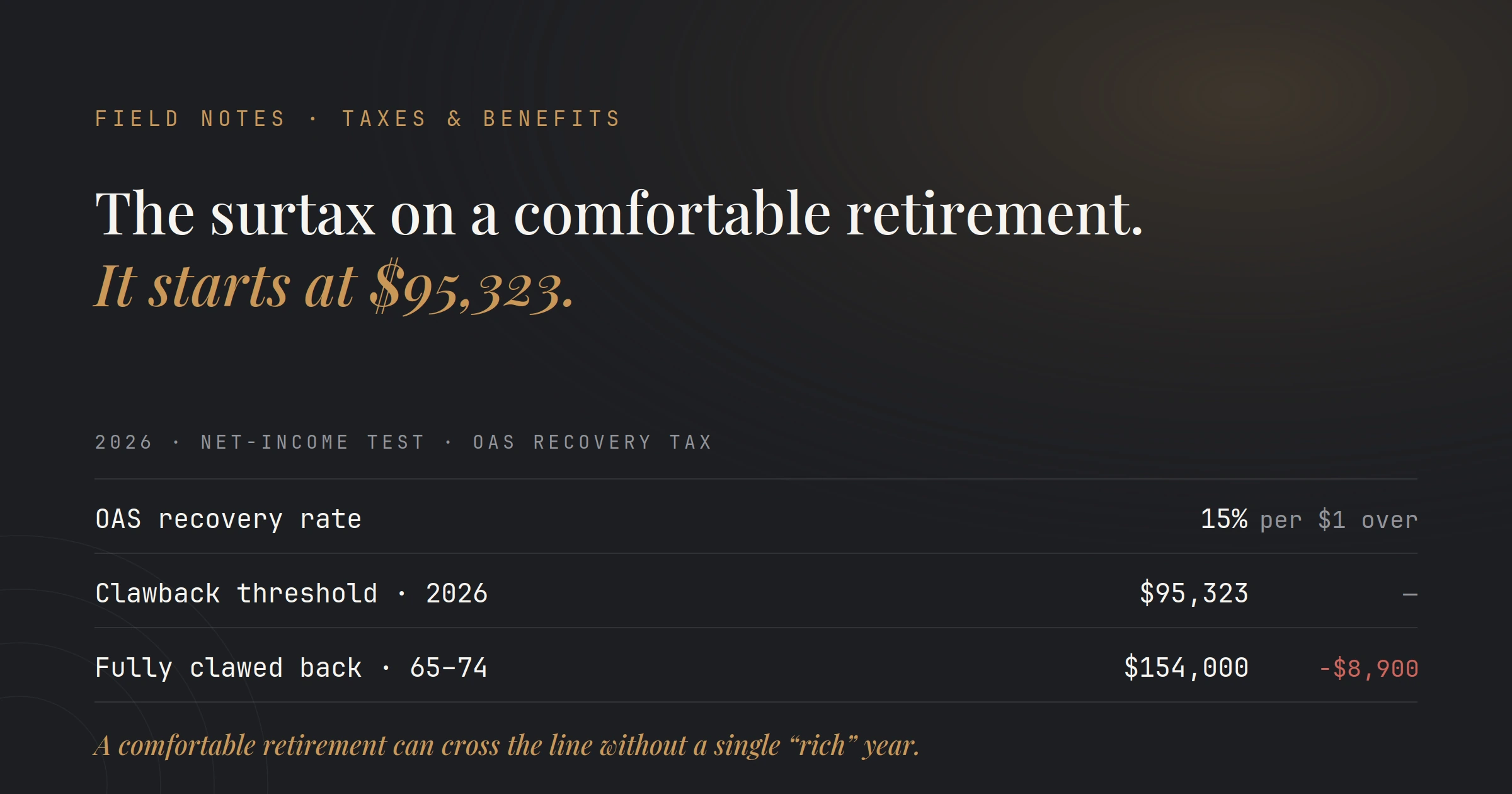
- The income you can count on. CPP, OAS and any workplace pension, and when each one starts.
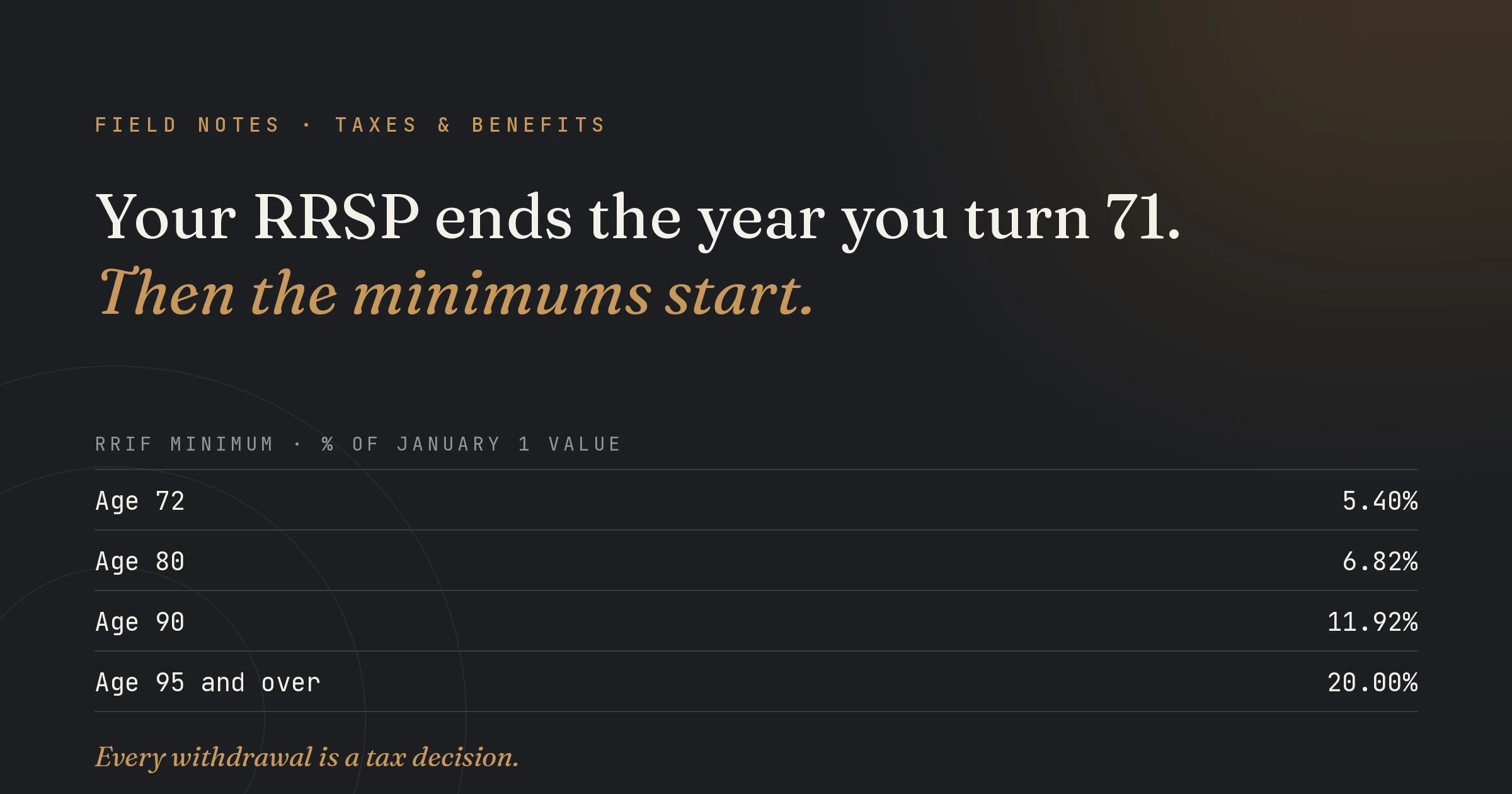
- Tax. Most retirement money comes out of an RRSP or RRIF, and every dollar of that is taxed as income.
- The order markets deliver their returns. Two people with the same average return can end decades apart, depending on when the bad years land.
Every question below is a version of the same one. Here’s what decides each, and how to work it out for your own numbers.
Can I afford to retire?
You can afford to retire when the money you have, plus the income you can count on, pays for what you spend, after tax, for as long as you live, and still does that if markets have a weak run early on.
That last part is the one most calculators leave out. A single projection line assumes average returns arriving on schedule. Real returns arrive in a random order, and a crash in the first few years of retirement does far more damage than the same crash twenty years in, because you’re selling investments to live while prices are down. We wrote about this in the most dangerous number in your retirement plan.
So “can I afford it?” is best answered as a range: in how many plausible futures does the money last?
Do I have enough to retire?
“Enough” is only meaningful next to what you spend. $800,000 can be plenty for a couple with two indexed pensions, and not nearly enough for someone retiring at 55 with no pension and $90,000 a year of spending.
A useful way to see it: take what you plan to spend each year after tax, subtract what CPP, OAS and pensions will pay once they start, and look at the gap. Your savings have to fill that gap, plus the tax on what you withdraw to fill it, every year until the guaranteed income takes over — and for life if it never fully does.
How much do I need to retire?
There’s no national figure, because it depends on the gap above and on how long you need to fill it. Three things move it most:
- Your spending. Every $10,000 a year of spending has to be funded for every year of retirement.
- Your start age. Retiring before CPP and OAS start means your savings carry the whole load for those years.
- Your guaranteed income. A defined-benefit pension that rises with inflation does the work of a large amount of savings.
Rules of thumb, like the often-quoted “4% rule”, give a starting point, but they were built on other countries’ markets and leave out Canadian tax, CPP and OAS. Your own numbers are a better guide than any multiplier.
Can I retire with $1 million?
Maybe. $1 million is a large sum, but on its own it answers nothing. Compare two households, both with $1 million saved:
- One retires at 55, spends $70,000 a year after tax, has no pension, and needs its savings to carry everything for ten years before CPP and OAS start.
- The other retires at 65, has two workplace pensions, spends $60,000 a year, and needs its savings only to top up the guaranteed income.
The second is far more likely to last. The first may still work, but it rests much more on markets being kind in the early years. Where most of the $1 million sits matters too: $1 million in an RRSP is worth less to spend than $1 million in a TFSA, because every RRSP dollar is taxed when it comes out.
Can I retire at 55, 60 or 65?
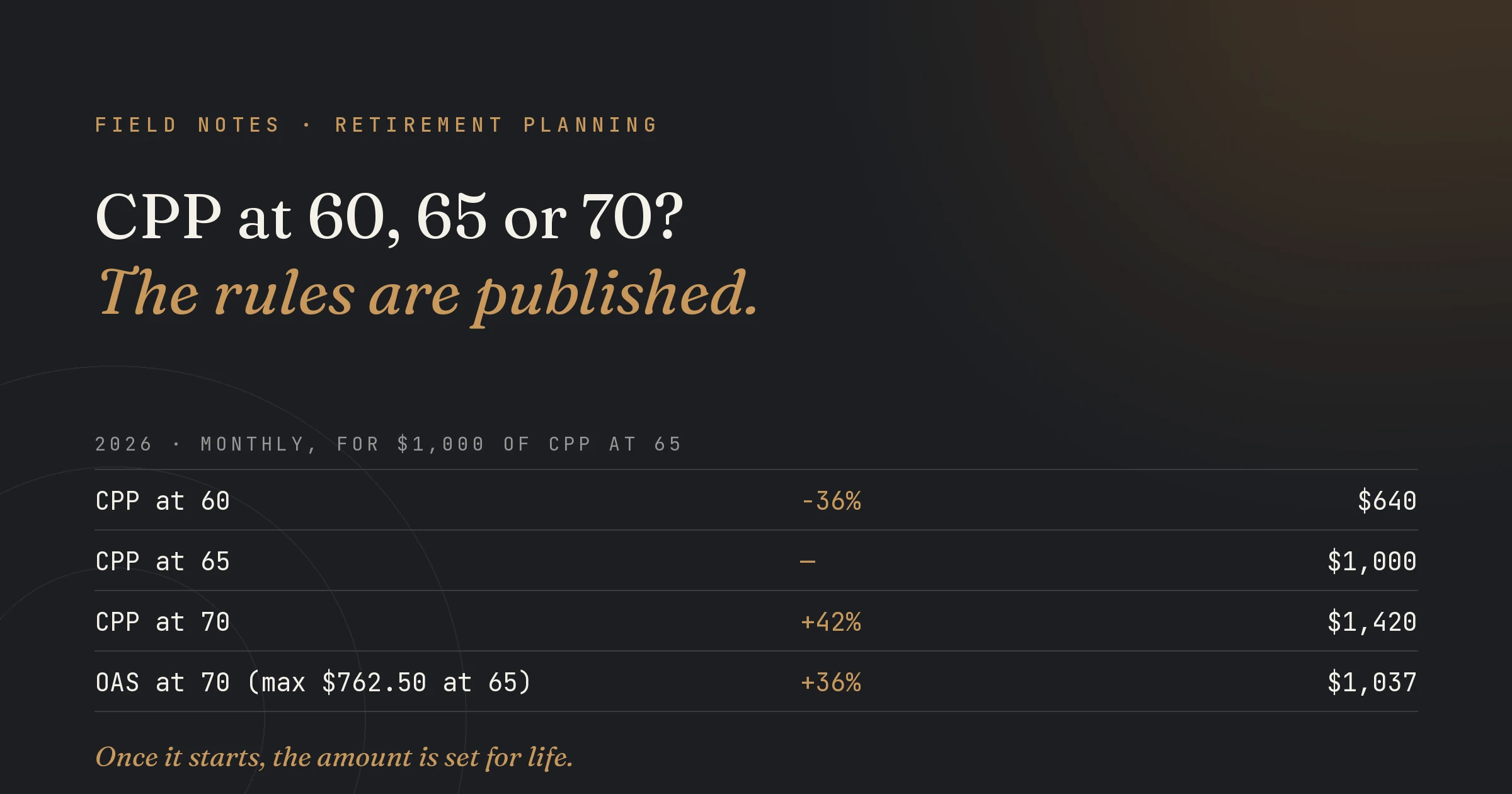
Each earlier year changes the plan in three ways at once: one less year of saving, one more year of withdrawals, and more years before CPP and OAS start, unless you take them early at a reduced rate. CPP can start at 60, reduced by 36%; OAS can’t start before 65.
So retiring at 55 usually means your savings carry the whole household for ten years. Retiring at 60 shortens that to five. At 65, CPP and OAS can start the same year. The answer depends on whether your savings can carry the years before your guaranteed income starts without leaving too little for the decades after. Our article on when to take CPP and OAS covers the start ages.
How long will my money last in retirement?
The honest answer is a range, not a year. In a plan run across thousands of possible market histories, the money lasts to 95 in some, runs out at 85 in others, and the spread between them is the real information.
A useful way to read the range is to choose how much good luck you’re willing to count on. Arthea calls this a planning stance: Prudent (P25) plans on a result that three in four futures beat, and Stress Test (P10) on one that nine in ten beat. A plan that still lasts at Prudent rests on less luck than one that only works at the middle.
How much can I spend in retirement?
The amount you can spend each year so the money lasts as long as you need it to, in the futures you’ve chosen to plan for. It isn’t a fixed percentage. It depends on your age, your guaranteed income, the accounts the money sits in, and the tax on getting it out.
It also isn’t the same every year. Spending often runs higher in the early, active years and falls later. A plan that spends more at 66 and less at 82 can last as long as one that spends the same amount every year.
Working it out for your own numbers
Arthea is a free retirement planner for Canadian households. Where a retirement calculator or a retirement income calculator gives you one line, Arthea takes your accounts, your spending, your CPP, OAS and pensions, and runs 10,000 possible futures, with tax worked out every year, all in today’s dollars. Then the Compare page answers these questions directly:
- What if we retire earlier — or later? Runs your plan again with a different retirement age, on the same market path, so the only difference is the age.
- How much can we spend? Shows whether you could spend more, or may want to spend less, for the money to last under the planning stance you choose.
- What if we couldn’t count on CPP and OAS? Takes government benefits out of the plan, so you can see how much of it rests on them.
The forecast itself shows how long the money lasts across the whole range, not just in the middle.
Next: when to take CPP and OAS, and RRSP withdrawals and tax in retirement.
Sources
- CPP start age and reduction: Government of Canada, When to start your CPP retirement pension (page dated 2026-10-02).
- OAS start age: Government of Canada, When to start your OAS pension (page dated 2026-10-02).
Arthea is an educational and analytical tool for Canadian households. It does not provide personalized financial, tax, or investment advice.