When to start CPP and OAS is one of the few retirement decisions that is permanent. Once your pension starts, the amount is set for life, rising only with inflation. It’s also one of the few with a clear set of published rules, so it’s worth knowing exactly what they say before deciding anything.
The rules below are the Government of Canada’s, as published in October 2026. Amounts are in today’s dollars, since both pensions rise with the cost of living.
When should I take CPP?
Any time between 60 and 70. The rules for how the amount changes are simple:
- Before 65, your pension is reduced by 0.6% for every month you start early: 7.2% a year, up to 36% less if you start at 60.
- After 65, it is increased by 0.7% for every month you wait: 8.4% a year, up to 42% more if you start at 70.
So a pension of $1,000 a month at 65 would be $640 a month at 60, or $1,420 a month at 70, for life.
Which is better depends mostly on three things: how long you expect to live, whether you need the income now, and what else you’d be drawing on while you wait. Your own estimate for each start age is in your My Service Canada Account, and it’s worth getting before you compare anything. In Quebec, the QPP has its own rules, published by Retraite Québec.
CPP at 60 or 65?
Taking CPP at 60 gets you five years of payments that waiting would not. Taking it at 65 gets you a larger payment for the rest of your life. Using the $1,000-at-65 example, the person who started at 60 is ahead until about age 74. After that, the person who waited is ahead, and the lead grows every year.
That break-even age leaves out tax and what the money earns while you have it, and both matter. Starting early can make sense if you need the income, if your health or family history points to a shorter life, or if the alternative is selling investments in a bad market. Waiting can make sense if you have other money to live on and expect a long life. Neither choice is right for everyone, and the break-even age is a guide, not a verdict.
CPP at 65 or 70?
Waiting from 65 to 70 raises the payment by 42%: $1,000 becomes $1,420 a month in the example. The person who started at 65 has five years of payments in hand, about $60,000, and the person who waited catches up at about age 82.
Waiting to 70 is often discussed as a way to insure against a long life: a larger pension that rises with inflation and never runs out, however long you live. The cost is the five years in between, which have to be funded from somewhere. For many people that somewhere is their RRSP, which links this choice to the next article, on RRSP withdrawals before 71.
When should I take OAS?
OAS can start at 65 at the earliest, and you can delay it up to 70:
- Each month you wait after 65 raises it by 0.6%: 7.2% a year, up to 36% more at 70.
- At 75, OAS rises a further 10%, a permanent increase made in July 2022.
- The maximum for October to December 2026 is $762.50 a month from 65 to 74, and $838.75 a month from 75.
Delaying the full $762.50 to 70 makes it about $1,037 a month. The person who started at 65 stays ahead until about age 84.
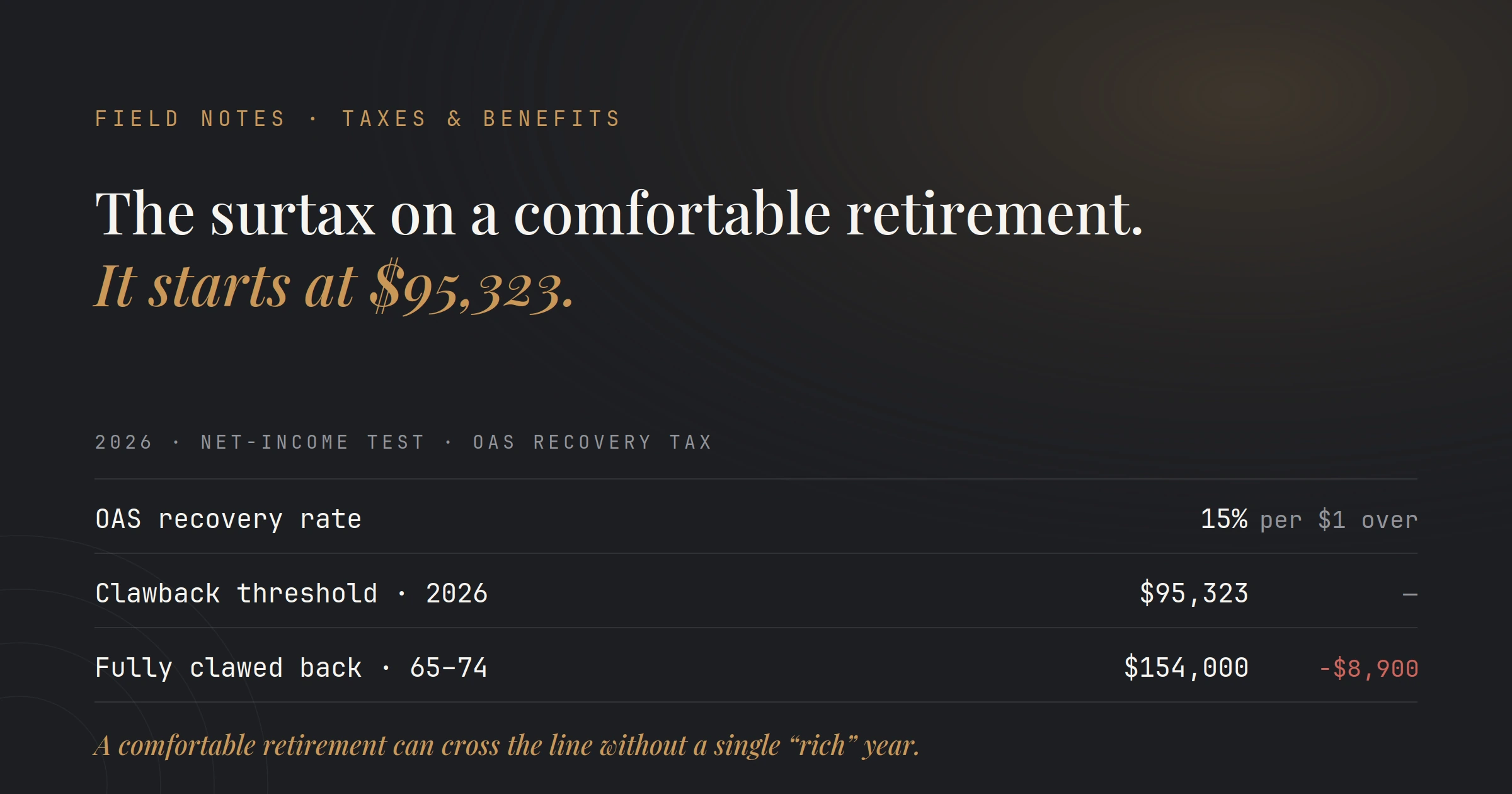
The other thing that shapes the OAS decision is the recovery tax, usually called the clawback. If your net income is above $95,323 for the 2026 income year, 15% of the amount above that is taken back out of your OAS. If your income in your late 60s would be high enough that the clawback takes much of your OAS anyway, delaying means you don’t receive it in those years, and it starts later at a higher rate. We explain how the clawback works, and how RRIF withdrawals can push you into it, in the OAS clawback article.
Working it out for your own numbers
Arthea is a free retirement planner for Canadian households. For each person you enter the CPP and OAS amount and the age it starts. Arthea doesn’t work out the change for starting early or late itself: you enter the amount you’d receive at the age you choose, from your Service Canada estimate or with the rules above. To compare two start ages, run the forecast with one, change the age and amount, and run it again.
Each forecast works out the tax every year, including the OAS clawback, across 10,000 possible futures, in today’s dollars. You see how the choice changes what your savings have to cover, how long the money lasts, and the tax you pay along the way. The Compare page’s What if we couldn’t count on CPP and OAS? shows how much of your plan rests on them.
Next: can I afford to retire?, and RRSP withdrawals and tax in retirement.
Sources
- CPP: Government of Canada, When to start your CPP retirement pension (page dated 2026-10-02).
- OAS start age and delay: Government of Canada, When to start your OAS pension (page dated 2026-10-02).
- OAS amounts and the increase at 75: Government of Canada, OAS payment amounts (page dated 2026-09-29; amounts for October to December 2026).
- OAS recovery tax: Government of Canada, OAS recovery tax (page dated 2026-09-29; threshold for the 2026 income year).
- Break-even ages are our arithmetic from those rules, before tax and investment growth.
Arthea is an educational and analytical tool for Canadian households. It does not provide personalized financial, tax, or investment advice.