Saving for retirement is mostly one decision made over and over: put money away. Spending it is harder, because every withdrawal is also a tax decision. Which account you draw from, and when, changes how much of your money reaches you, how much of your OAS you keep, and how much tax is left for your estate.
These three questions are where most of that is decided.
Should I take money out of my RRSP before 71?
First, the rule. By the end of the year you turn 71, your RRSP has to end: you withdraw it, transfer it to a RRIF, or use it to buy an annuity. Most people transfer it to a RRIF. From the year after the RRIF is set up, you must withdraw at least a minimum each year, a fixed share of its value on January 1 that rises with age:
| Age on January 1 | Minimum |
|---|---|
| 65 | 4.00% |
| 71 | 5.28% |
| 72 | 5.40% |
| 75 | 5.82% |
| 80 | 6.82% |
| 85 | 8.51% |
| 90 | 11.92% |
| 95 and over | 20.00% |
You can always take more than the minimum, never less. You can also elect to base the minimum on a younger spouse’s age when you open the RRIF.
So the real question is whether to take money out before the minimums force you to. The case for it: the years between stopping work and 72 are often your lowest-income years, especially if you delay CPP or OAS. Withdrawals in those years can be taxed at lower rates, and they shrink the RRIF, so the minimums later are smaller. Smaller minimums mean less taxable income in your 70s and 80s, which can mean less OAS clawed back and less tax on the RRIF left at death.
The case against: you pay tax sooner, and money taken out stops growing tax-sheltered, unless you move it into a TFSA, where it grows tax-free again. Which one wins depends on your tax rates now and later, which nobody can see without working through your own numbers year by year. We go deeper into how RRIF minimums interact with the clawback in the OAS clawback article.
Which account should I withdraw from first in retirement?
There’s no single right order, but there is a reason behind most of them. Withdrawals from an RRSP or RRIF are taxed as income. Non-registered accounts are taxed only on the gain or income inside them. TFSA withdrawals aren’t taxed at all, and what stays in a TFSA keeps growing tax-free, which is why it usually comes last.
Arthea’s forecast takes your guaranteed income first: CPP, OAS, workplace pensions, rent, any amounts you set yourself, and the required RRIF and LIF minimums. Then it draws only what is still needed to reach the year’s income goal after tax, in this order:
- RRSP, RRIF, FHSA, LIRA and LIF, up to the top of the lowest federal tax bracket for each retired person, the spouse with the lower taxable income first
- then corporate and non-registered accounts, whichever leaves more after tax first
- then RRSP, RRIF, FHSA, LIRA and LIF above that bracket
- then the TFSA, last, because it grows tax-free
The idea behind the first step is to use each person’s lowest tax bracket every year rather than leave it empty, so less of the RRSP is taxed at higher rates later. That’s how the forecast works your plan out, not advice on what you should do. You can change any withdrawal yourself on the Planning Workbook and see what it does.
How much tax will I pay in retirement?
It depends on what your income is made of, because each kind is taxed differently:
- RRSP and RRIF withdrawals, CPP, OAS and workplace pensions are taxed as ordinary income.
- In a non-registered account, interest is taxed in full, Canadian dividends receive a tax credit, and only half of a capital gain is taxed.
- TFSA withdrawals aren’t taxed.
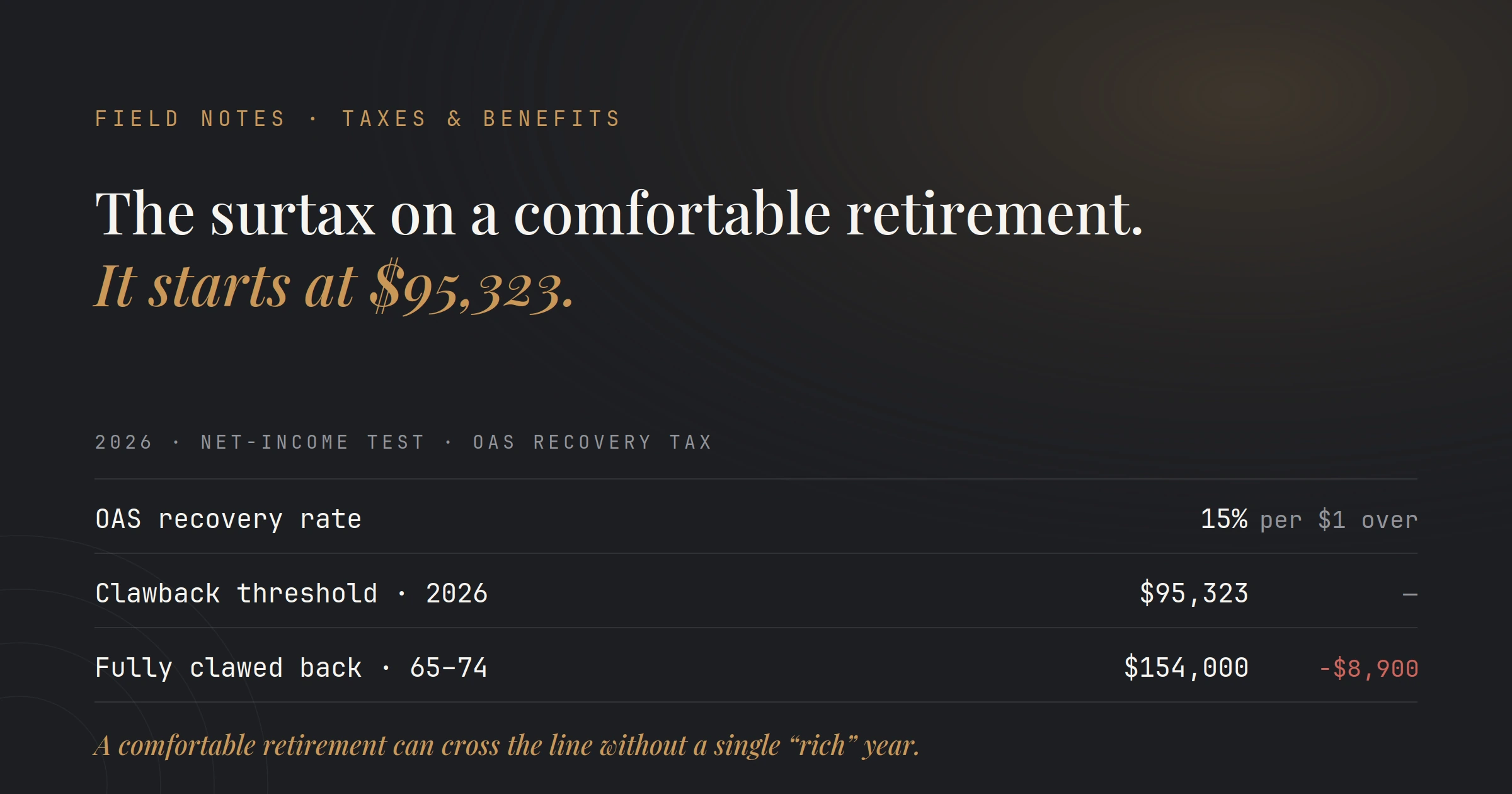
- The OAS clawback takes back 15% of net income above $95,323 (2026 income year) out of your OAS, which works like an extra 15% tax in that band.
Couples can split eligible pension income, which includes RRIF withdrawals from 65, and that can lower the total tax when one spouse has much more income than the other.
One thing that surprises people: the tax withheld from a withdrawal isn’t the tax you owe. Outside Quebec, the bank withholds 10%, 20% or 30% of the amount above your RRIF minimum, depending on its size, and nothing on the minimum itself. Your actual tax is settled when you file, and the difference shows up as a refund or a balance owing.
Working it out for your own numbers
Arthea is a free retirement planner for Canadian households, with federal and provincial tax, including Quebec’s, worked out every year of the forecast:
- Compare → When should our RRSP withdrawals start? sets three options side by side: starting at 55, your plan as it stands, and waiting until the minimums at 72. For each, it shows household tax year by year and in total, the OAS clawed back, and the RRSP and RRIF balance.
- Income & Taxes shows each person’s income and tax for every year of the plan.
- The Planning Workbook shows what is drawn from each account each year, and lets you change it.
Everything is in today’s dollars, and every figure comes from the same 10,000 possible futures.
Next: can I afford to retire?, and when to take CPP and OAS.
Sources
- RRSP options by the end of the year you turn 71: Canada Revenue Agency, Options for your own RRSPs.
- RRIF minimum withdrawal factors: Canada Revenue Agency, Chart: prescribed factors. The factors haven’t changed since 2015; below 71, the minimum is 1 ÷ (90 − age).
- OAS recovery tax: Government of Canada, OAS recovery tax (page dated 2026-09-29; threshold for the 2026 income year).
Arthea is an educational and analytical tool for Canadian households. It does not provide personalized financial, tax, or investment advice.