You did everything right. You fed the RRSP for thirty years, watched it compound, and arrived at retirement with a balance that finally feels like enough. Then, somewhere in your seventies, the government quietly starts taking back a benefit it was paying you — Old Age Security — at fifteen cents on the dollar. Nobody sends a bill. Your OAS deposit just gets smaller.
That’s the OAS clawback, and the frustrating part is who it catches: not the wealthy so much as the comfortable. A retiree with a decent pension, full CPP, and a healthy RRSP can walk into it without a single “rich” year — often pushed over the line by withdrawals they were forced to make.
It isn’t a tax on being rich. It’s a tax on a number.
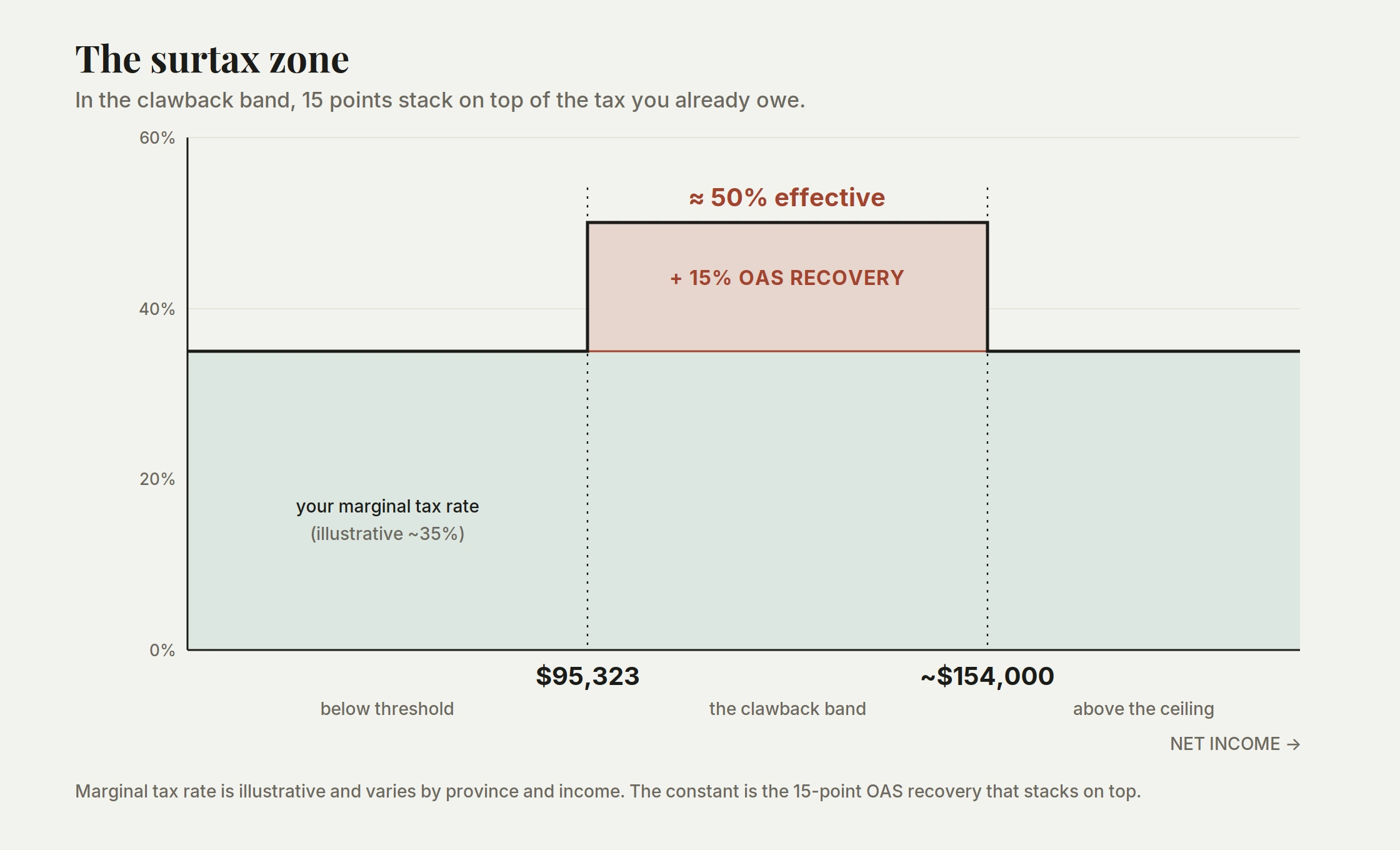
The clawback — officially the OAS pension recovery tax — is triggered by one figure: your net income for the year. For 2026, the line is $95,323. Earn a dollar more than that, and the government recovers 15 cents of your OAS for every dollar above it. Go far enough over and your OAS disappears entirely — around $154,000 of net income if you’re 65 to 74, and around $161,000 if you’re 75 or older. (Those two ceilings are CRA estimates until they’re finalized late in the year; the $95,323 starting line is set.)
Two things make this sting more than the headline suggests.
First, it’s assessed per person, not per household — each spouse has their own threshold, which turns out to be a planning opportunity we’ll come back to.
Second — and this is the real point — it’s a surtax, not just a clawback. The 15% recovery sits on top of the regular income tax you already owe on that same dollar. So in the income band between the threshold and the ceiling, your true marginal rate isn’t your tax bracket — it’s your bracket plus fifteen points. For a comfortable retiree, that can mean handing back close to half of every additional dollar. And that band is exactly where comfortable retirements live.
Where your RRIF walks you into it
Here’s how ordinary retirees end up in that band without trying: the RRIF.
By the end of the year you turn 71, your RRSP can’t stay an RRSP. You have to convert it — almost everyone converts to a Registered Retirement Income Fund — and a RRIF comes with a string attached: a mandatory minimum withdrawal every year, whether you need the money or not. The minimum is a percentage of your January 1 balance, set by the CRA, and it climbs every year you age: about 5.28% at 71, 5.82% at 75, 6.82% at 80, 8.51% at 85, and just shy of 12% at 90.
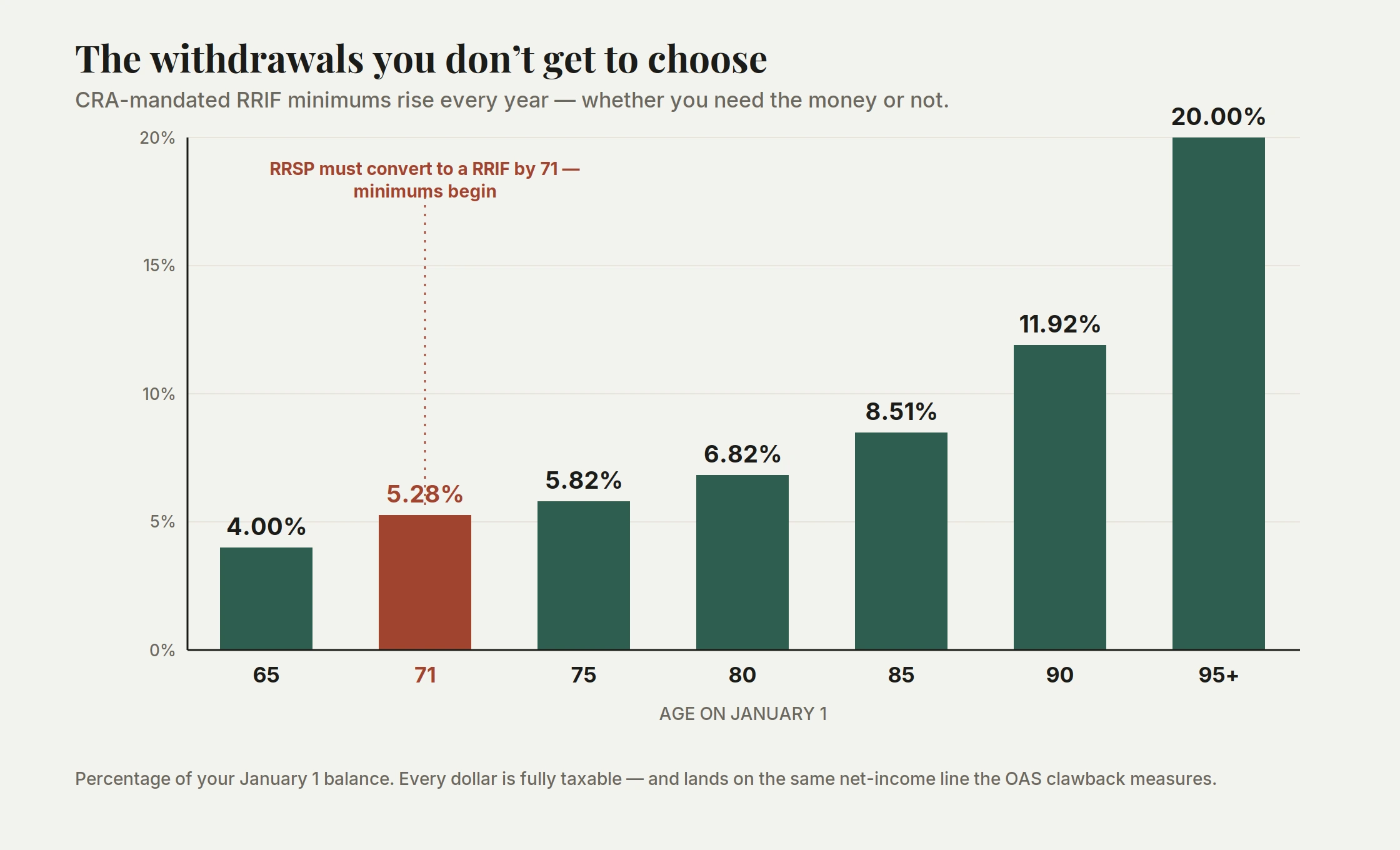
Every dollar of that withdrawal is fully taxable income. It stacks on top of your CPP, your OAS, and any workplace pension — and it all lands on the same net-income line the clawback is measured against. The larger the RRSP you so carefully built, the larger the forced withdrawal, and the easier it is to be pushed past $95,323 by money you didn’t choose to take out.
A comfortable example
Meet a retiree — call her Margaret, 74, with an $800,000 RRIF on January 1. Her required withdrawal for the year is the age-74 factor, about 5.7%, or roughly $45,000. Add close to full CPP of about $17,000, a $30,000 workplace pension, and her OAS, and her net income lands near $101,000 — around $5,600 past the line.
So she hands back about 15% of that excess — roughly $840 of her OAS — and every extra dollar she chooses to draw is taxed at her regular rate plus fifteen points. She never felt rich. She had a good pension, a full CPP, and a RRIF doing exactly what the rules force it to do.
The quiet part
Two mechanics make the clawback easy to miss until it’s already happening.
It runs on a lag. OAS is paid on a July-to-June cycle, and the reduction to your cheques from July 2026 through June 2027 is based on your 2025 income — not this year’s. The pension arriving today reflects a return you filed months ago, so by the time a big withdrawal shows up as a smaller cheque, it’s a year later and feels disconnected from the cause.
The income test is broader than your bank statements. It’s net income on your return, which counts things that never landed in your account as cash. The classic trap is Canadian dividends: they’re “grossed up” by 38% for tax purposes, so $40,000 of dividend cash shows up as roughly $55,000 of income — inflating the very number the clawback measures. The one large exception worth memorizing: TFSA withdrawals don’t count at all. They’re invisible to the clawback.
What you can actually do
None of this is a reason to fear a big RRSP — it’s a reason to manage the drawdown on purpose. The levers, in plain terms:
- Split it. Pension income splitting, and a younger-spouse election on your RRIF (using the younger partner’s age to shrink the forced minimum), both move income off the higher earner’s threshold and toward the lower one.
- Melt the RRSP down early. The years between retiring and 71 are often your lowest-bracket years. Drawing the RRSP down voluntarily in that window — before the minimums take over — can shrink the balance that later drives those forced withdrawals.
- Lean on the TFSA. Because TFSA withdrawals don’t count as income, a dollar spent from the TFSA in a high-income year can keep you under the threshold in a way a RRIF dollar never will.
- Consider deferring OAS. Waiting past 65 (up to 70) raises your eventual OAS and can be paired with an earlier RRSP meltdown to reshape which years you’re exposed.
- Time your capital gains so a one-off sale doesn’t spike a single year over the line.
The discipline is the same one that runs through all of this: don’t let the tax tail wag the dog — never distort a sound plan just to dodge a threshold — but do treat retirement as a sequence of years and decide, on purpose, which income lands when.
The point
The OAS clawback isn’t a penalty for being wealthy. It’s a quiet surtax on a comfortable retirement, and the most common way in is a RRIF doing precisely what it’s required to do. You can’t opt out of the minimums — but you can decide, years ahead, how much income lands in which year, and keep more of a benefit you spent a working life paying for.
Arthea models this directly — where your RRIF withdrawals land you against the clawback, in today’s dollars, across the full range of outcomes rather than one tidy line. See yours at arthea.ca.
Related reading: the most dangerous number in your retirement plan — why a single projected line to 95 hides exactly this kind of risk.
Arthea is an educational and analytical tool for Canadian households. Tax figures — including the 2026 threshold, the 15% recovery rate, and the RRIF minimum factors — are general, current as of writing, and can change; the upper clawback ceilings are CRA estimates until finalized. This is not tax, investment, or financial advice, or a recommendation to buy, sell, or withdraw from any account. Consult a licensed professional before acting.