You spent hours picking low-fee index funds. You agonized over your stock-to-bond split. And then, at the last step, you did what almost everyone does: you dropped those funds into whichever account happened to have room.
That last step is a tax decision — and it’s the one most DIY investors never make on purpose. Which asset lives in your RRSP, which in your TFSA, and which in your non-registered account changes how much of your return the government takes. Over decades, getting it wrong can quietly cost you more than the fund fees you worked so hard to shrink.
This is asset location — not to be confused with asset allocation (how much you hold of each thing). Allocation is the big decision. Location is the tax-efficiency layer on top of it, and it’s nearly free money.
Same asset, three completely different tax bills
Here’s the thing that makes location matter: your RRSP, TFSA, and non-registered account each tax the same dollar of return differently.
- In a TFSA, growth and income are tax-free — forever.
- In an RRSP, everything is sheltered as it grows; you pay tax only when you withdraw. But remember - the Canadian Government is your silent partner in this account - they want their share of the pie when you withdraw.
- In a non-registered account, you’re taxed every year — and how you’re taxed depends on the type of income. Interest is taxed at your full marginal rate. Canadian dividends get a credit. Capital gains are half-taxed (though this is subject to change when, in 2025, the Liberal government tried to sneak up the inclusion rate to over 60%)
So the identical fund can have three different after-tax returns depending purely on the envelope it sits in. Put the wrong asset in the wrong envelope and you leak return every single year.
The rules of thumb
None of this is exotic. It comes down to matching each asset to the account that taxes it most kindly.
Interest-bearing assets — bonds, GICs, high-interest savings — belong in your RRSP (or TFSA). Interest is the worst-treated income in a non-registered account: taxed at your full marginal rate, every year, no break. Shelter it. Leaving your bonds in a taxable account is the single most common — and most expensive — location mistake.
U.S. and foreign dividend stocks lean toward your RRSP. This is the one almost nobody knows. Under the Canada–U.S. tax treaty, U.S. dividends are exempt from the 15% U.S. withholding tax when the stock is held in an RRSP. Hold that same U.S. dividend payer in a TFSA and you lose 15% of those dividends permanently — the withholding still applies, and a tax-free account has no tax to credit it against. (This is exactly the “TFSA foreign-withholding drag” Arthea models.) In a non-registered account you at least recover it via the foreign tax credit. So the ranking for U.S. dividends is: RRSP best, non-registered okay, TFSA worst.
Canadian dividend stocks are fine in a non-registered account. Eligible Canadian dividends get the dividend tax credit, which makes them relatively tax-friendly even when they’re exposed — and that credit is wasted inside an RRSP or TFSA, where there’s no tax to reduce. So if you’re out of registered room, Canadian dividend payers are a reasonable thing to hold taxably.
Your highest-growth assets want your TFSA. Every dollar of growth in a TFSA is tax-free, permanently. So the assets you expect to grow the most — where the gain, not the dividend, is the story — get the most out of that shelter.
The trap that catches almost everyone
Notice the tension: “highest growth goes in the TFSA” and “U.S. dividends go in the RRSP” can point in opposite directions for the same holding. The most common casualty is a big U.S. dividend ETF parked in a TFSA because the TFSA “is for your best stuff.” It feels right, and it quietly bleeds 15% of the dividends to Washington with no way to get it back.
The honest resolution: match by income type./clear Pure growth with a tiny dividend? TFSA is still great. Dividend-heavy U.S. holding? It’s usually happier in the RRSP.
How much is this actually worth?
Let’s be honest about the size of the prize, because the internet oversells it. Asset location is a second-order move — your allocation (how much equity vs. fixed income) matters far more than where you put each piece. If you only get one thing right, get the allocation right.
But the drag from misplacement is real, and it compounds. Held over decades, the annual tax bleed on bonds sitting in a taxable account, or U.S. dividends trapped in a TFSA, can add up to more than your funds’ MERs — the very costs you minimized so carefully. Arthea models this drag directly, in today’s dollars, so you can see the cost of leaving interest exposed rather than guess at it.
The catch — and a caution
Location only matters if you have meaningful balances across more than one account type. If everything you own sits in a TFSA, there’s no decision to make. It starts to bite once you’re spread across all three — like a household with, say, a $442,000 RRSP, a $210,000 non-registered account, and a $94,000 TFSA. That’s exactly when the envelopes start pulling in different directions.
Two cautions before you rearrange anything. Don’t let the tax tail wag the investment dog — never buy an asset you don’t actually want just because it fits an account nicely. And don’t trigger a big taxable sale in your non-registered account just to relocate something; the capital-gains tax to move it can dwarf the location benefit. The cleanest way to fix location is with new money — direct fresh contributions to the right envelope as you go, rather than reshuffling what’s already there.
The point
You optimized the fund. Now optimize the envelope it lives in. The same portfolio, arranged with a little tax awareness, quietly keeps more of your return — no extra risk, no market call, no cleverness required. It’s one of the few genuinely free lunches in investing. Not flashy. Just money you stop leaking.
See what your own accounts are costing — or saving — you at arthea.ca.
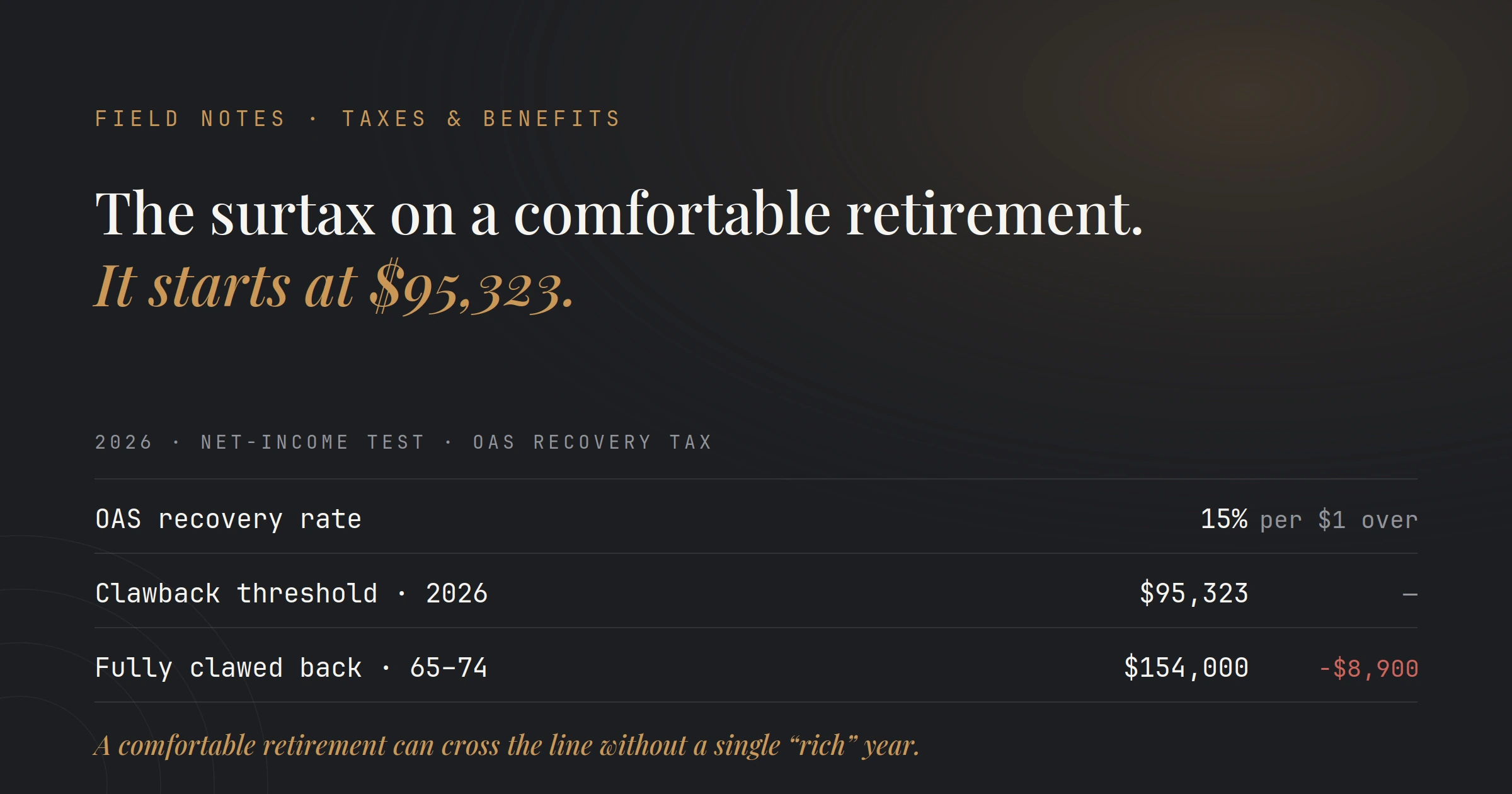
Next in Field Notes: the surtax on a comfortable retirement — how the OAS clawback works, and why your RRIF withdrawals can quietly trigger it.
Arthea is an educational and analytical tool for Canadian households. Tax rules — including treaty treatment and withholding — are general, can change, and depend on your specific situation. This is not tax, investment, or financial advice, and not a recommendation to buy, sell, or relocate any security. Consult a licensed professional before acting.